Your work often explores the tension between control and freedom. Can you describe a moment in the studio when a painting has completely escaped your original intentions, and what that taught you about your own creative process?
I have different ways of starting paintings and often I work on more than one at once because it enables me to process and articulate several ideas at the same time. I can carry out those ideas on different canvases or forms without them all competing with one another and this means that each one of those paintings is then articulated for a different idea and a progressive iteration. They are sometime small nudges but also can be bigger ideas about shape, technique or materials and that means that different surfaces and forms become linked with a continuous theme even though they might appear visually quite different.
I feel that this speaks a lot of the human condition for people who have busy minds and a lot of ideas. There is a calmness that’s obtained by focusing on a few precise moments and channelling them into separate outcomes.
Whenever I have started a painting with a pre-determined plan and have tried to stick to it, the painting doesn’t work. There is an air of discomfort, and it becomes contrived. It works much better to have a general plan of the particular contrasts I want to set up and for the techniques that I am going to use and to then refine those and bring them into a satisfying aspect within the individual work.
Sometimes the idea doesn’t articulate itself in the same way that had been imagined in the mind’s eye because it seems to be an impossible task to guide the immaterial visual into material being. That means that the materials do a lot of ‘the talking’ for the painting as they then form this kind of outcome that had been unexpected, but which also is a product of the artist’s experience and skill with the materials. I do make sure that the paint application is a refined and finely tuned experience befitting of the quality of the end crafting. Where there are areas that the paint leaks or spreads in an uncontrolled way, this creates a difficult feeling for me, as messiness feels like something that is not wanted or expected and will be judged. But in the end, I learn to enjoy and embrace it for its character and the way in which it brings this conversation to life. Leaking a little is like a twist in the intention that isn’t within my control, but that’s an interesting moment.
As a result, I have made a habit of approaching the canvas with very much an open mind about what is going to happen. There are so many difficult decisions to make to ensure that this valuable material isn’t wasted and that the slightest wrong move doesn’t mean huge dissatisfaction or even repulsion at something feeling uncomfortable.
I can stand at the edge of the canvas with the colour decided, the paint mixed to a desirable colour and consistency and then the real moment of truth about the success of the painting is held in the single moment that I choose to make the first mark or pour. But then things relax and the smaller decisions lead the painting on, one at a time. It does feel a little like standing on the edge of a rock being about to jump into the sea but it’s like making the first move in anything in life, you start something and it feels like a huge gamble with an unknown outcome where you don’t know how it will go, and you have to then respond to what you are met with in the next brave manner. Fortunately for me, I have always worked on a large scale ever since I was a student and that means doing big paintings doesn’t scare me.
All images © Trudie Moore

You worked with Bridget Riley during workshops in the 1990s, and colour remains central to your practice. Looking back, what is the single most important lesson you carried forward from that experience, and how has your interpretation of colour evolved since then?
I was so fortunate in the 90s to have had such a huge artist icon Bridget Riley carry out some workshops on colour. I remember trying to colour match to samples of her paintings and how difficult it was to obtain the exact hue and shade of a colour and to match it. Something so simple is a masterclass of precision and refinement and really looking hard. It’s so easy to imagine a colour, think that you have got it and then to realise that the visual frequency that the imagined colour was is such a long way away from that.
A whole lifetime could be spent in achieving this sort of precision and it really teaches you to look, think and create slowly and to give an extreme level of depth to the decision. This has stayed with me in my practice and as a result, the method of staying visually simple and being exacting was a lesson in the essence of abstraction.
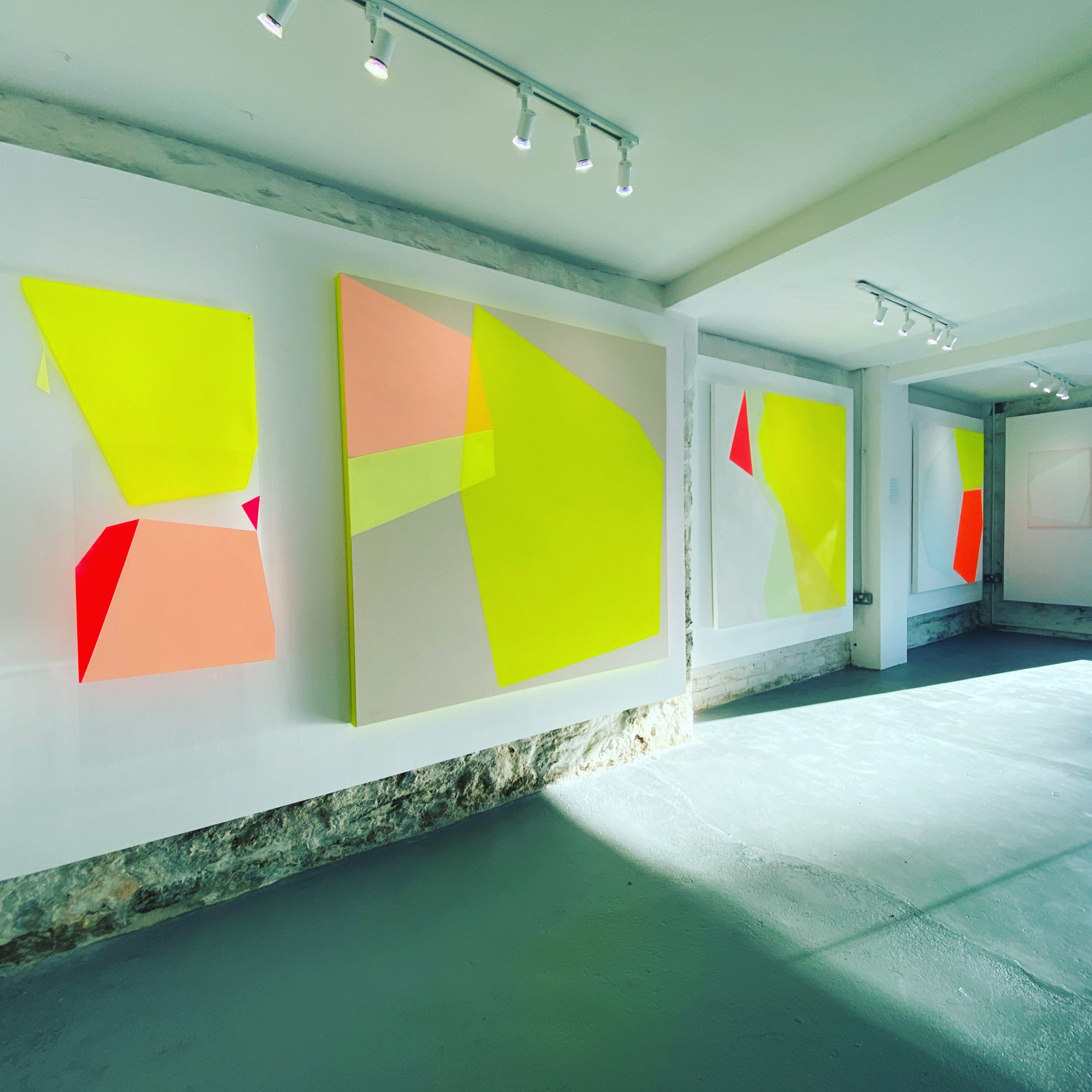
I used to work with a full colour range that included greys and browns and what I would say were richer, earthier and solid or bold colours, but as time has gone on the palette has lightened and narrowed into clear and clean colours that feel comfortable to me. But being comfortable with colour to me doesn’t mean being safe. The colours I use are often rebellious, risky and challenging and maybe a little anarchistic, whilst being also clean, pure and full of light. There is a purposefulness to the light and bright colours because they are uplifting to those who are open to them, but equally they scare and repel others, especially those who want to stay in a ‘safe zone’.


Cornwall is often associated with landscape painting, yet your work communicates through abstraction, light and material. How does living and working here influence your decisions without becoming the subject of your paintings?
Living in Cornwall and being surrounded by many landscape artists is a frank reminder of why I do what I do and why I enjoy it. It could be so easy to try to be someone else or to replicate the work of others to feel as though fitting in is the thing someone should be doing. Some of my very early paintings had elements of abstracting from the seen world in them but I felt more strongly excited by a purer abstraction that started in the 90s which was known as process painting – a variety of analogue treatments and experimental interventions superimposed upon the canvas. This innovative approach has informed my work as it opened my eyes to something that was completely new. What I really enjoy is creating challenging art that lives more on the edge of adventure. This is definitely a more difficult and independent path to follow that requires greater inner strength and conviction, I enjoy doing something that is different to others.
I spend a lot of time in nature and the wildness of the west coast with its elemental winds, risky seas and quieter places stops me from feeling confined and makes me feel more expansive. It’s impossible to keep these feelings out of the artworks as they are what creeps in to every part of life. The colour has evolved in line with these connections to nature and light and the purity of it. There have been some strong moments of what feels like channelling light into the paintings.
Materials-wise there is an aspect that links too and the synthetic paints are in strong contrast to the natural fibres of bare canvas. I like to touch and feel the sand, rocks, trees and feel purified by being in cold water. There are textures and shapes that Barbara Hepworth and the other famous artists of Penwith used in abstracted ways and I can feel the similarities and draw connections between the different elements of the landscape, those historic artists’ work and my work even though I’m not working in the same space that they were.


Your practice moves beyond canvas into acrylic constructions and installations that alter the viewer’s perception of space. What draws you towards these physical interventions, and how do you want people to feel when they encounter them in person?
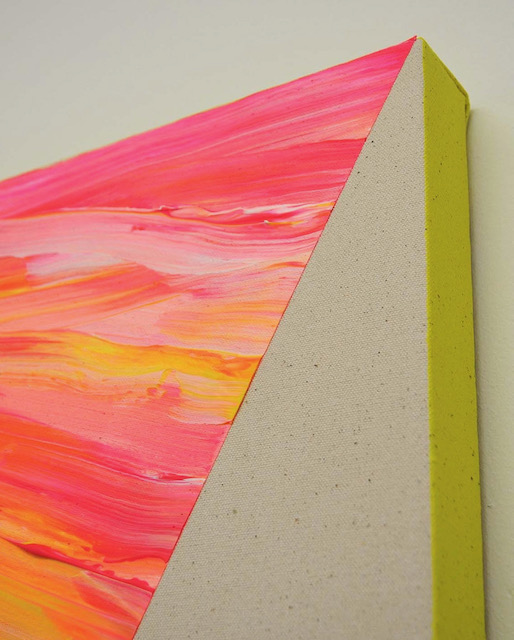
My acrylic constructions are an exercise into immersing people into more than one dimension, that of the two dimensional becoming three dimensions which then impact upon the fourth dimension (which l see as the glow of the paint coming into the room from the canvas) and then the fifth dimension, which I like to call the spiritual or emotional impact on their body and soul.
There is an experience of colour and an embodiment of it upon the person as they stand in the presence of it. For me personally the large yellow fields radiate warmth into my core and fill my eyes with a sort of stimulating dopamine hit that I don’t experience any other way. I have witnessed people physically change, straighten their posture and become more animated as they are hit by the impact of the paintings. They know they are drawn to walk over to them and just after they are stood in front of them the mental and physical uplift takes hold. It’s an exciting prospect to find something that can help people to feel good and create a sort of social impact, especially when times are so difficult to navigate.
My work is an exercise in communicating through experience and feeling and if that’s the main takeaway from what people see then that means I have succeeded.
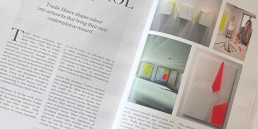
A long form interview that goes further into depth from The Edge of Control, a feature in Drift London. The questions in this article were supplied with thanks by Drift Journal.
Related Posts