

Creative process, colour and Cornwall’s light. Uplifting and communicating through sensation and materiality.

Your work often explores the tension between control and freedom. Can you describe a moment in the studio when a painting has completely escaped your original intentions, and what that taught you about your own creative process?
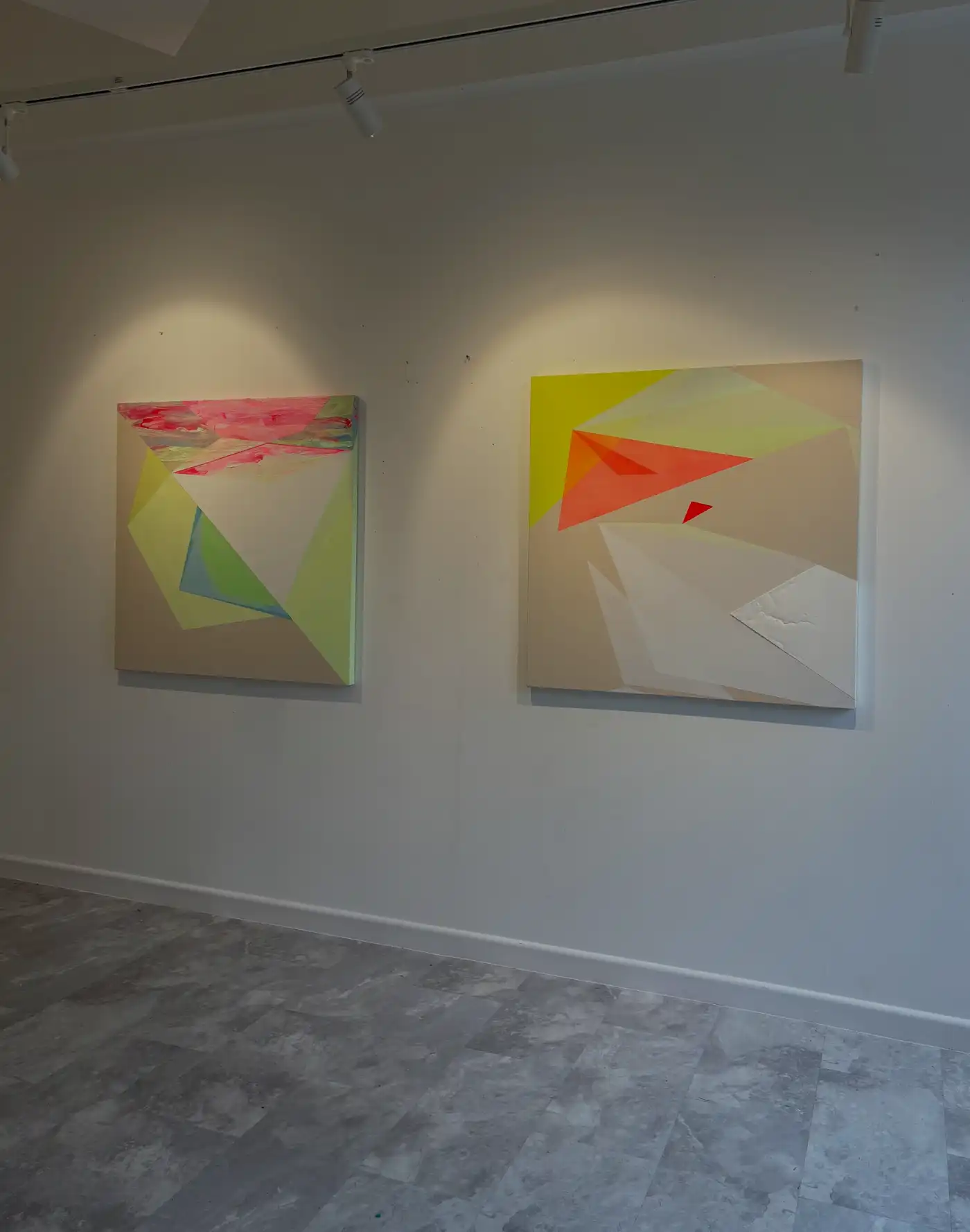
I have different ways of starting paintings and often I work on more than one at once because it enables me to process and articulate several ideas at the same time. I can carry out those ideas on different canvases or forms without them all competing with one another and this means that each one of those paintings is then articulated for a different idea and a progressive iteration. They are sometime small nudges but also can be bigger ideas about shape, technique or materials and that means that different surfaces and forms become linked with a continuous theme even though they might appear visually quite different.
I feel that this speaks a lot of the human condition for people who have busy minds and a lot of ideas. There is a calmness that’s obtained by focusing on a few precise moments and channelling them into separate outcomes.
Whenever I have started a painting with a pre-determined plan and have tried to stick to it, the painting doesn’t work. There is an air of discomfort, and it becomes contrived. It works much better to have a general plan of the particular contrasts I want to set up and for the techniques that I am going to use and to then refine those and bring them into a satisfying aspect within the individual work.
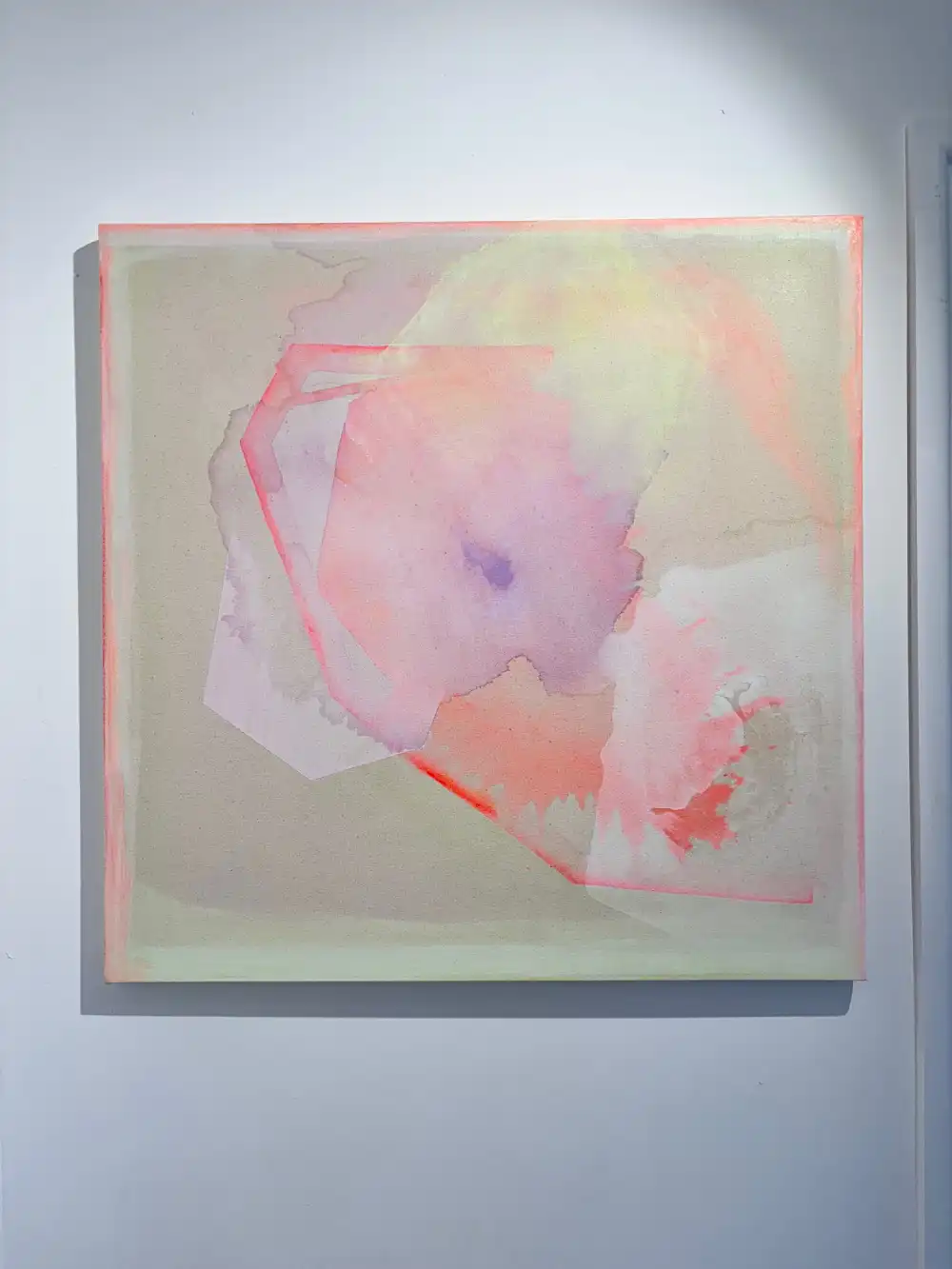
Sometimes the idea doesn’t articulate itself in the same way that had been imagined in the mind’s eye because it seems to be an impossible task to guide the immaterial visual into material being. That means that the materials do a lot of ‘the talking’ for the painting as they then form this kind of outcome that had been unexpected, but which also is a product of the artist’s experience and skill with the materials. I do make sure that the paint application is a refined and finely tuned experience befitting of the quality of the end crafting. Where there are areas that the paint leaks or spreads in an uncontrolled way, this creates a difficult feeling for me, as messiness feels like something that is not wanted or expected and will be judged. But in the end, I learn to enjoy and embrace it for its character and the way in which it brings this conversation to life. Leaking a little is like a twist in the intention that isn’t within my control, but that’s an interesting moment.
As a result, I have made a habit of approaching the canvas with very much an open mind about what is going to happen. There are so many difficult decisions to make to ensure that this valuable material isn’t wasted and that the slightest wrong move doesn’t mean huge dissatisfaction or even repulsion at something feeling uncomfortable.
I can stand at the edge of the canvas with the colour decided, the paint mixed to a desirable colour and consistency and then the real moment of truth about the success of the painting is held in the single moment that I choose to make the first mark or pour. But then things relax and the smaller decisions lead the painting on, one at a time. It does feel a little like standing on the edge of a rock being about to jump into the sea but it’s like making the first move in anything in life, you start something and it feels like a huge gamble with an unknown outcome where you don’t know how it will go, and you have to then respond to what you are met with in the next brave manner. Fortunately for me, I have always worked on a large scale ever since I was a student and that means doing big paintings doesn’t scare me.
All images © Trudie Moore

You worked with Bridget Riley during workshops in the 1990s, and colour remains central to your practice. Looking back, what is the single most important lesson you carried forward from that experience, and how has your interpretation of colour evolved since then?
I was so fortunate in the 90s to have had such a huge artist icon Bridget Riley carry out some workshops on colour. I remember trying to colour match to samples of her paintings and how difficult it was to obtain the exact hue and shade of a colour and to match it. Something so simple is a masterclass of precision and refinement and really looking hard. It’s so easy to imagine a colour, think that you have got it and then to realise that the visual frequency that the imagined colour was is such a long way away from that.
A whole lifetime could be spent in achieving this sort of precision and it really teaches you to look, think and create slowly and to give an extreme level of depth to the decision. This has stayed with me in my practice and as a result, the method of staying visually simple and being exacting was a lesson in the essence of abstraction.
I used to work with a full colour range that included greys and browns and what I would say were richer, earthier and solid or bold colours, but as time has gone on the palette has lightened and narrowed into clear and clean colours that feel comfortable to me. But being comfortable with colour to me doesn’t mean being safe. The colours I use are often rebellious, risky and challenging and maybe a little anarchistic, whilst being also clean, pure and full of light. There is a purposefulness to the light and bright colours because they are uplifting to those who are open to them, but equally they scare and repel others, especially those who want to stay in a ‘safe zone’.


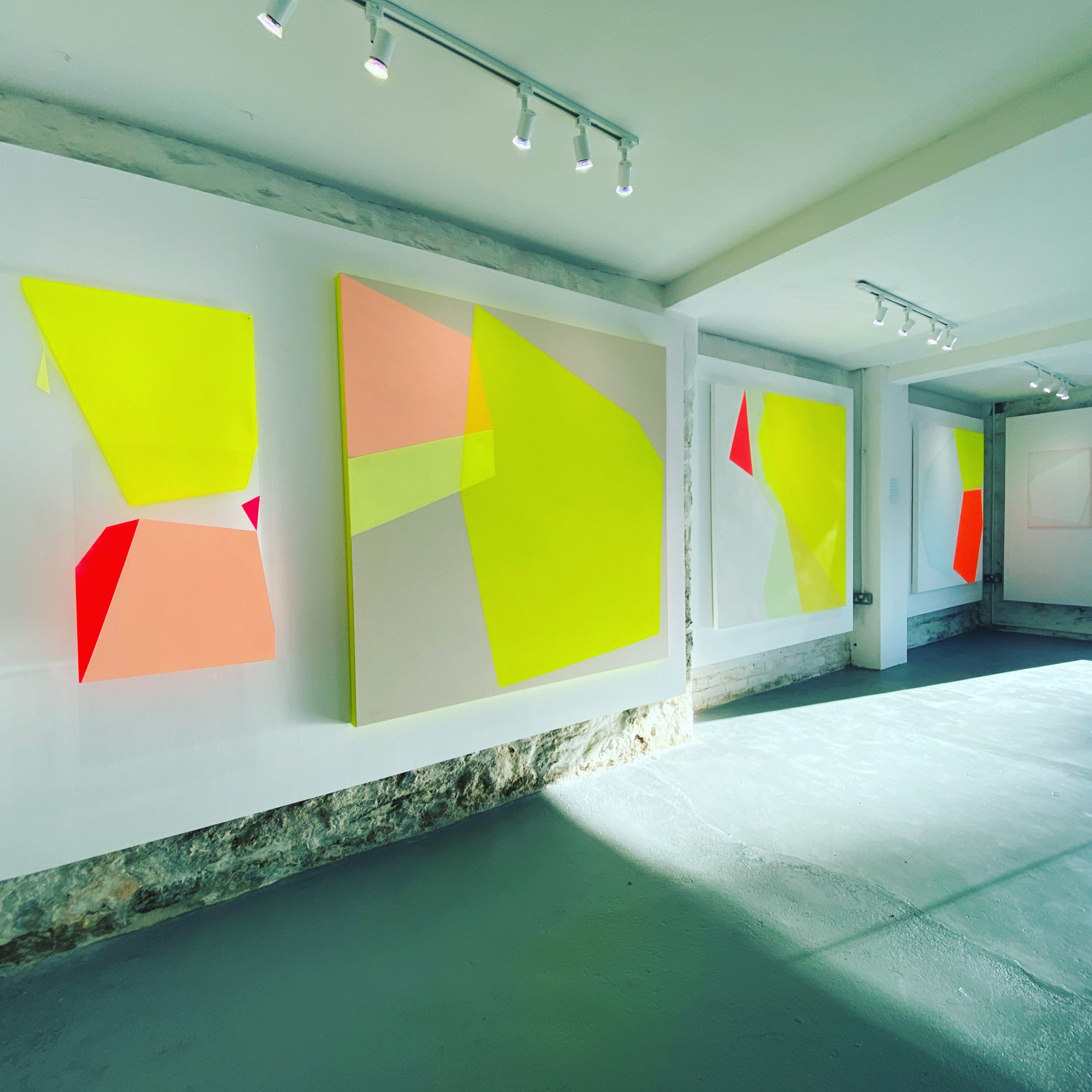
Cornwall is often associated with landscape painting, yet your work communicates through abstraction, light and material. How does living and working here influence your decisions without becoming the subject of your paintings?
Living in Cornwall and being surrounded by many landscape artists is a frank reminder of why I do what I do and why I enjoy it. It could be so easy to try to be someone else or to replicate the work of others to feel as though fitting in is the thing someone should be doing. Some of my very early paintings had elements of abstracting from the seen world in them but I felt more strongly excited by a purer abstraction that started in the 90s which was known as process painting – a variety of analogue treatments and experimental interventions superimposed upon the canvas. This innovative approach has informed my work as it opened my eyes to something that was completely new. What I really enjoy is creating challenging art that lives more on the edge of adventure. This is definitely a more difficult and independent path to follow that requires greater inner strength and conviction, I enjoy doing something that is different to others.
I spend a lot of time in nature and the wildness of the west coast with its elemental winds, risky seas and quieter places stops me from feeling confined and makes me feel more expansive. It’s impossible to keep these feelings out of the artworks as they are what creeps in to every part of life. The colour has evolved in line with these connections to nature and light and the purity of it. There have been some strong moments of what feels like channelling light into the paintings.
Materials-wise there is an aspect that links too and the synthetic paints are in strong contrast to the natural fibres of bare canvas. I like to touch and feel the sand, rocks, trees and feel purified by being in cold water. There are textures and shapes that Barbara Hepworth and the other famous artists of Penwith used in abstracted ways and I can feel the similarities and draw connections between the different elements of the landscape, those historic artists’ work and my work even though I’m not working in the same space that they were.

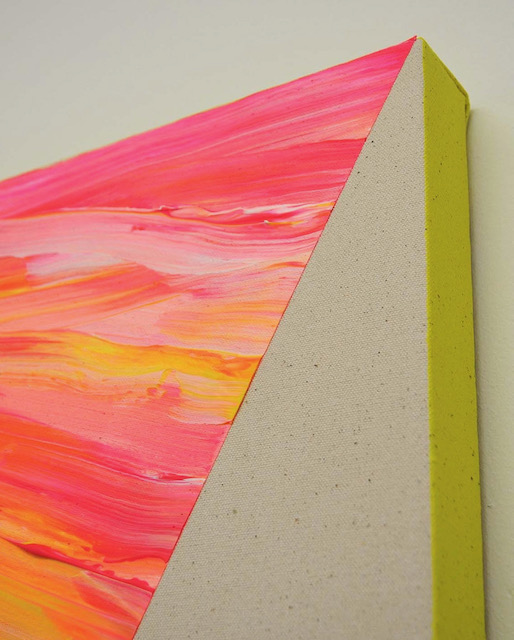

Your practice moves beyond canvas into acrylic constructions and installations that alter the viewer’s perception of space. What draws you towards these physical interventions, and how do you want people to feel when they encounter them in person?
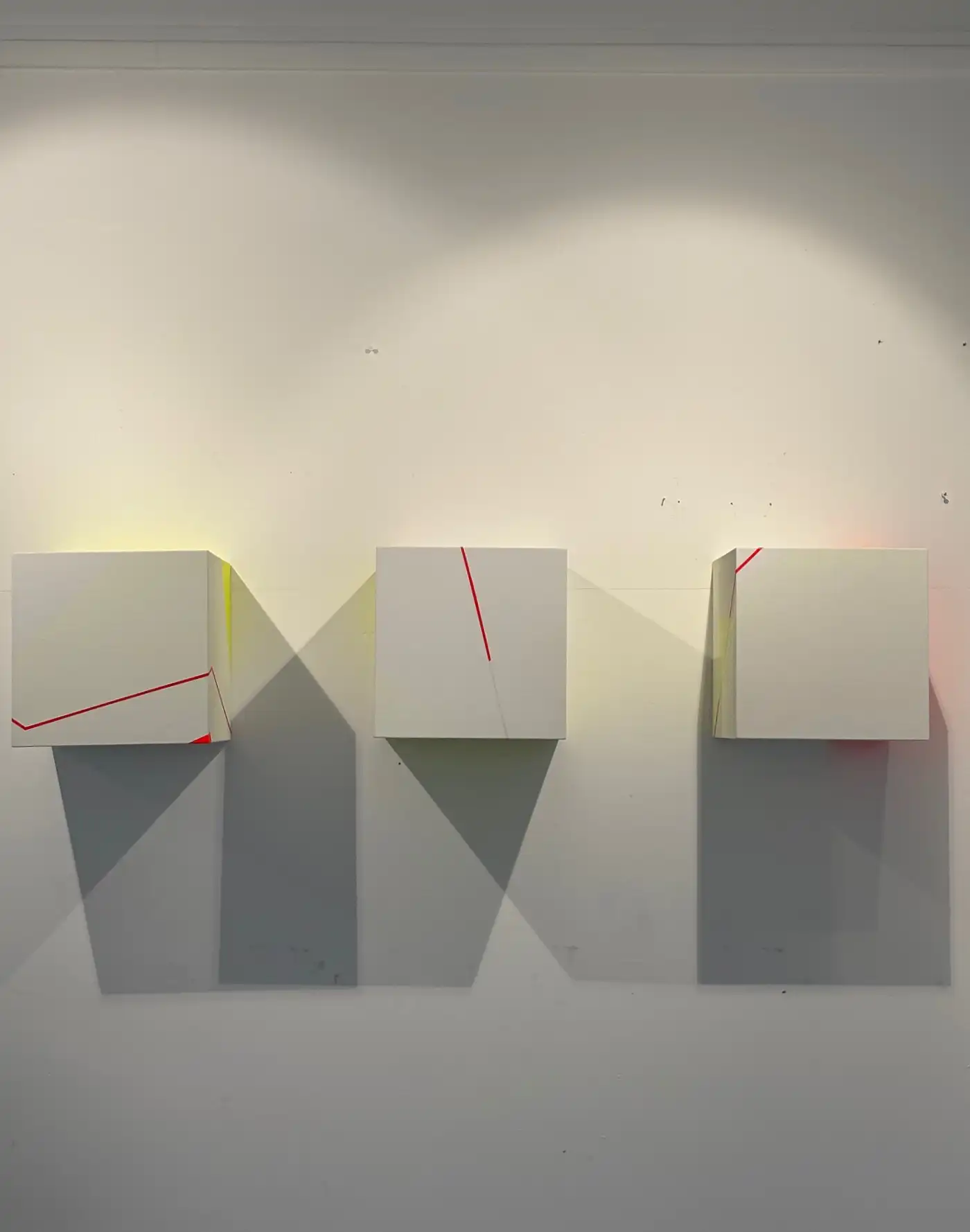
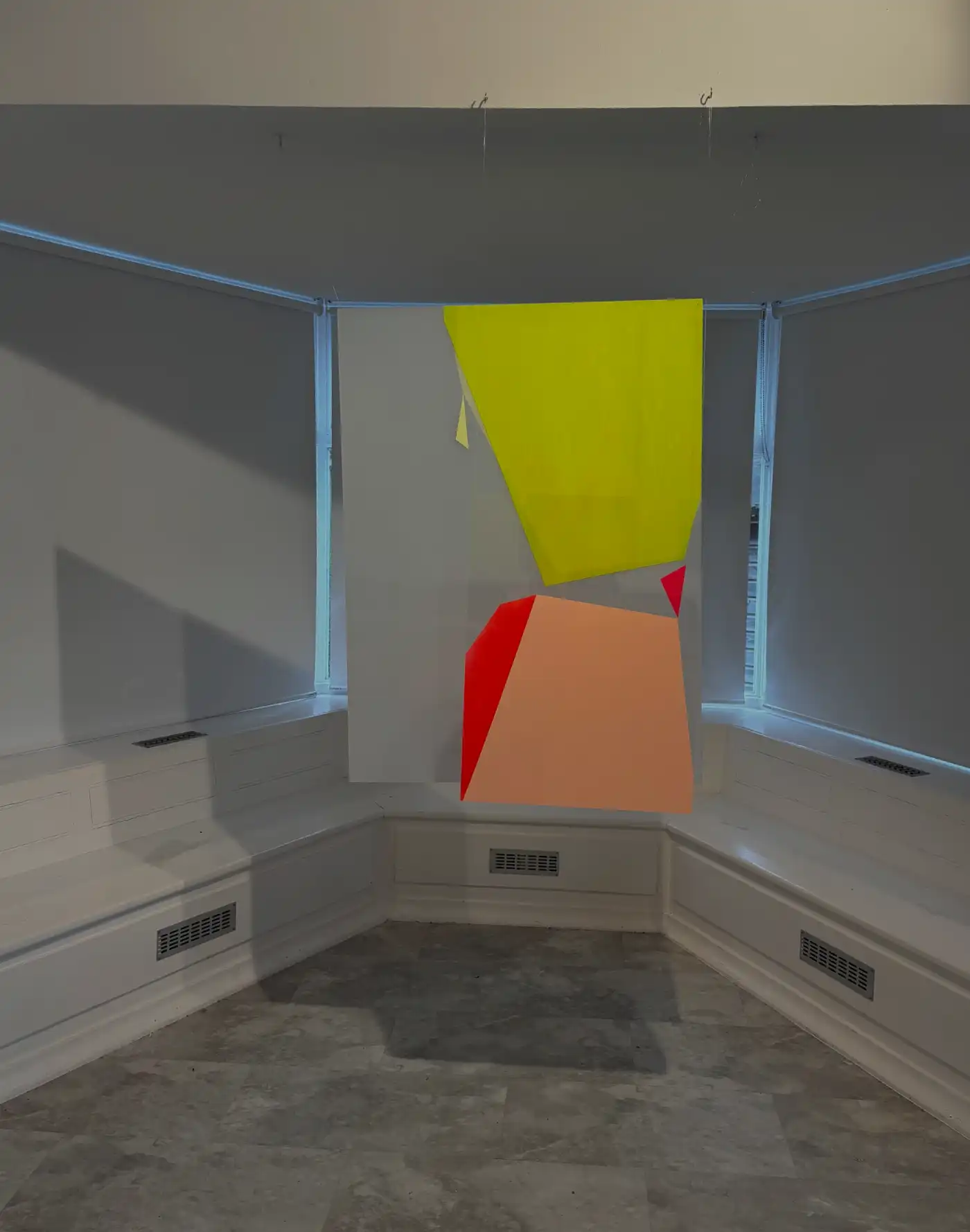
My acrylic constructions are an exercise into immersing people into more than one dimension, that of the two dimensional becoming three dimensions which then impact upon the fourth dimension (which l see as the glow of the paint coming into the room from the canvas) and then the fifth dimension, which I like to call the spiritual or emotional impact on their body and soul.
There is an experience of colour and an embodiment of it upon the person as they stand in the presence of it. For me personally the large yellow fields radiate warmth into my core and fill my eyes with a sort of stimulating dopamine hit that I don’t experience any other way. I have witnessed people physically change, straighten their posture and become more animated as they are hit by the impact of the paintings. They know they are drawn to walk over to them and just after they are stood in front of them the mental and physical uplift takes hold. It’s an exciting prospect to find something that can help people to feel good and create a sort of social impact, especially when times are so difficult to navigate.
My work is an exercise in communicating through experience and feeling and if that’s the main takeaway from what people see then that means I have succeeded.
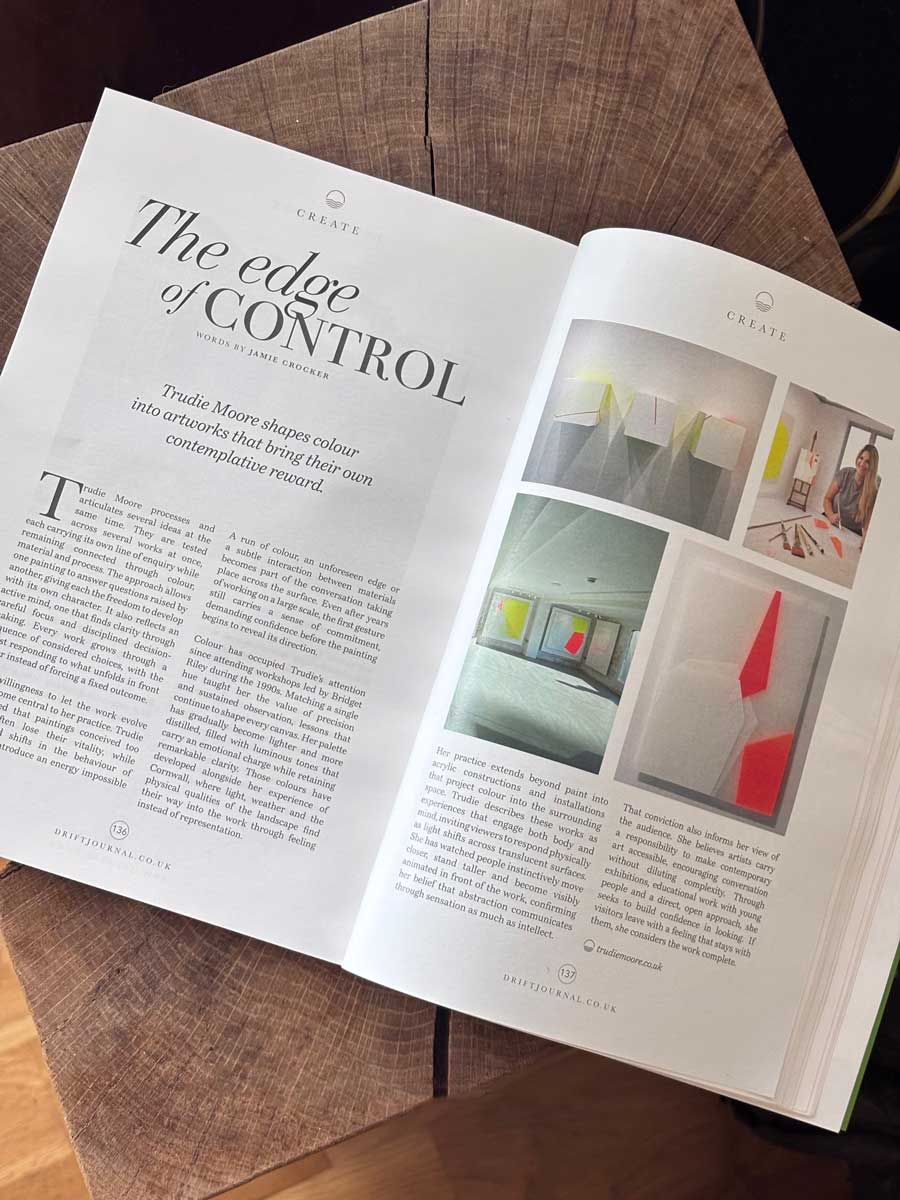
A long form interview that goes further into depth from The Edge of Control, a feature in Drift London. The questions in this article were supplied with thanks by Drift Journal.

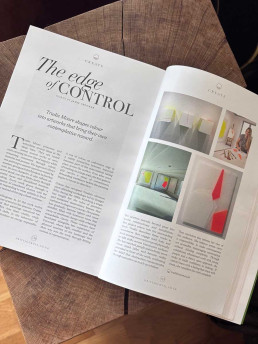
The edge of control - Drift Journal
The edge of control - Drift August 2026
This summer I spoke to Drift Journal about my process and living and making art in Cornwall and how it inevitably takes a role in shaping how the works present themselves.
In this article we talk about the influences over a long period of time, what I’m looking for in terms of how I control the artwork, my considered choices and how I allow it to evolve.
“..Trudie describes these works as experiences that engage both body and mind, inviting viewers to respond physically as light shifts across translucent surfaces. She has watched people instinctively move closer, stand taller and become visibly animated in front of the work, confirming her belief that abstraction communicates through sensation as much as intellect…”
Artist in Residence at Truro High School for Girls
Artist Gallery Residency
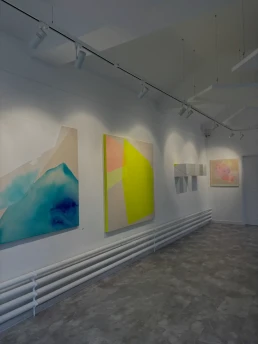
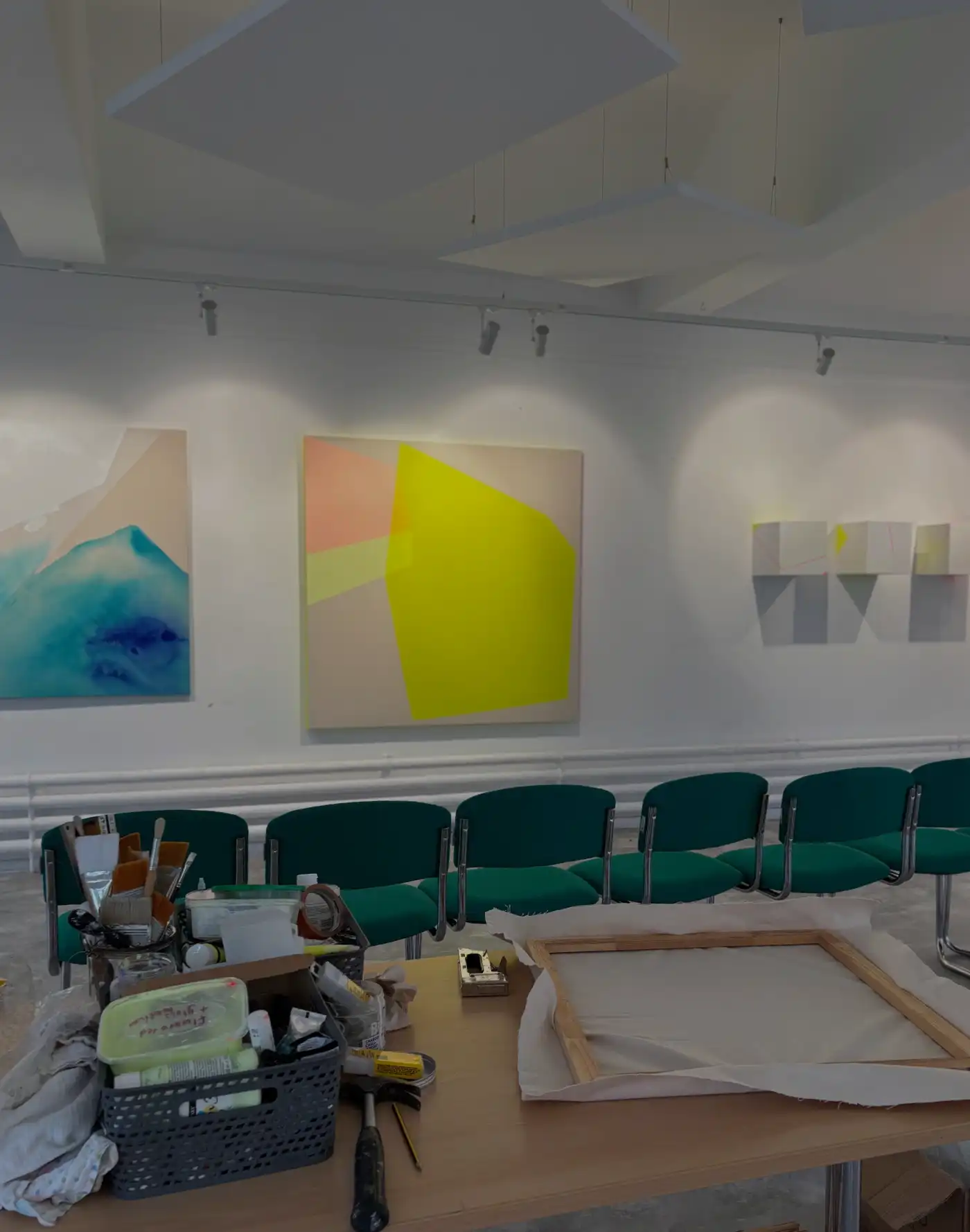
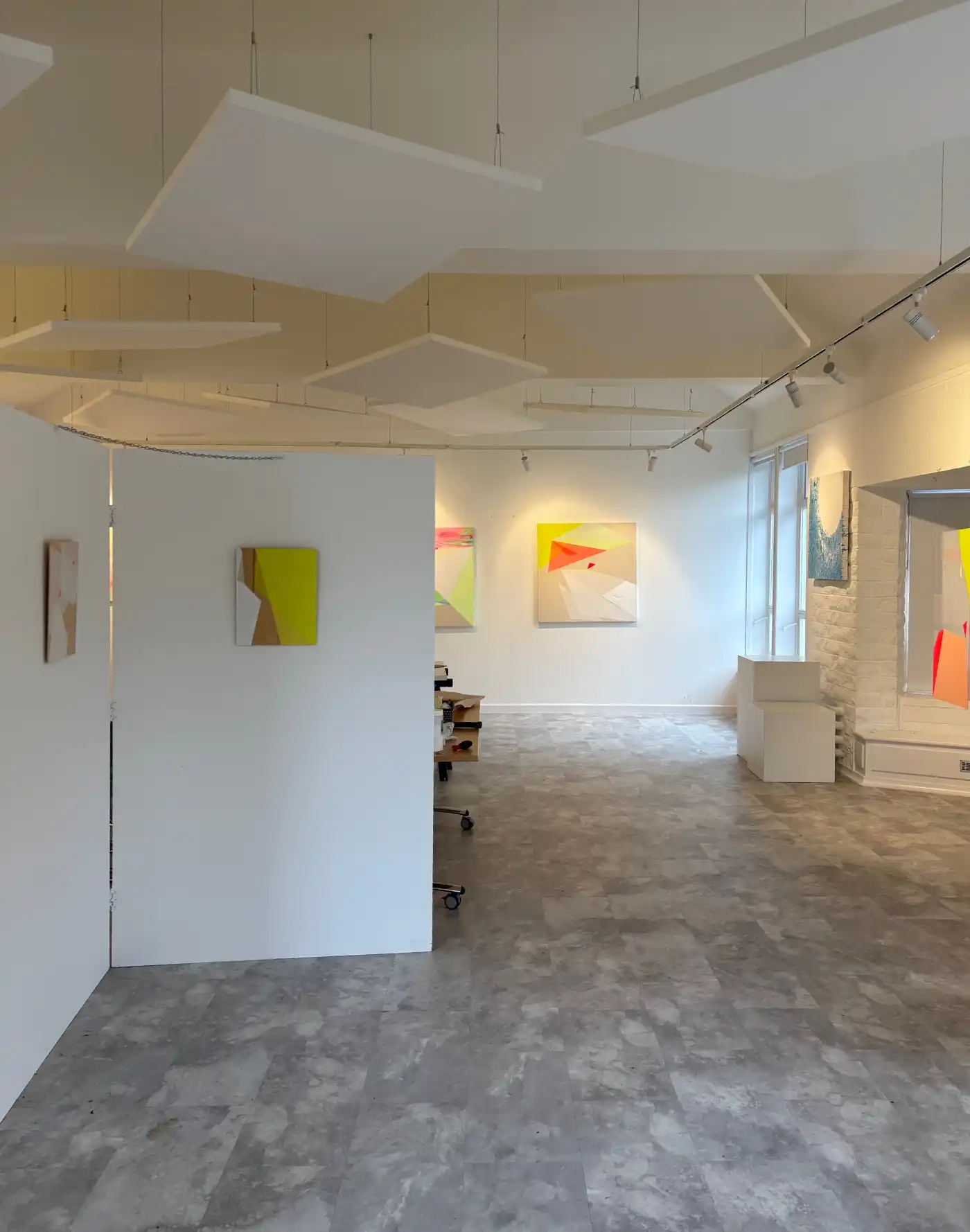
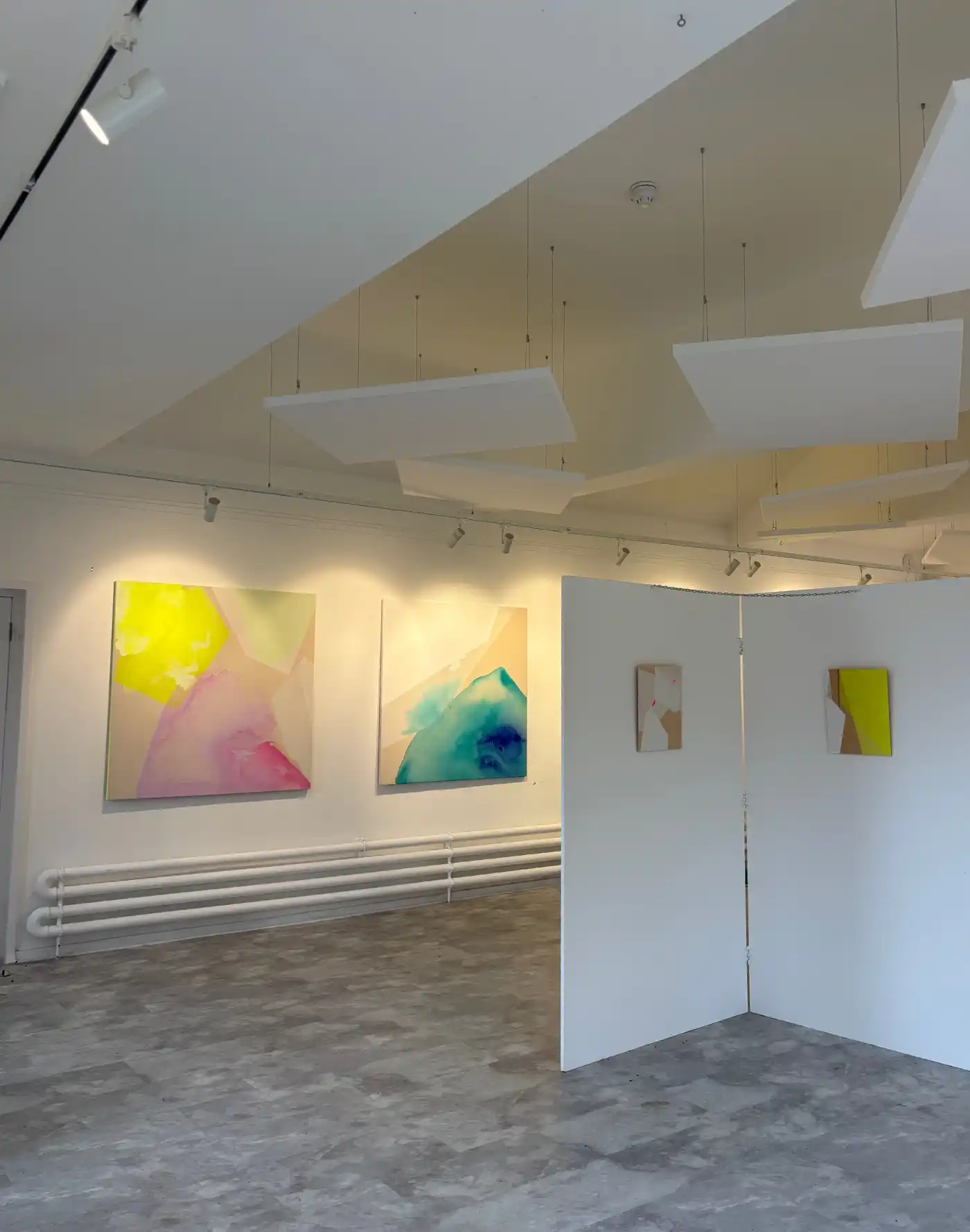
For the last fortnight I was delighted to take up residence in the gallery at Truro High School for Girls .
A lovely warm welcome was waiting for me over the last two weeks and it’s been a really varied experience to be in an educational setting and to take part in bringing abstraction and colour in contemporary art practice to these young people and seeing the different ways in which they can engage with it as a part of their academic syllabus.
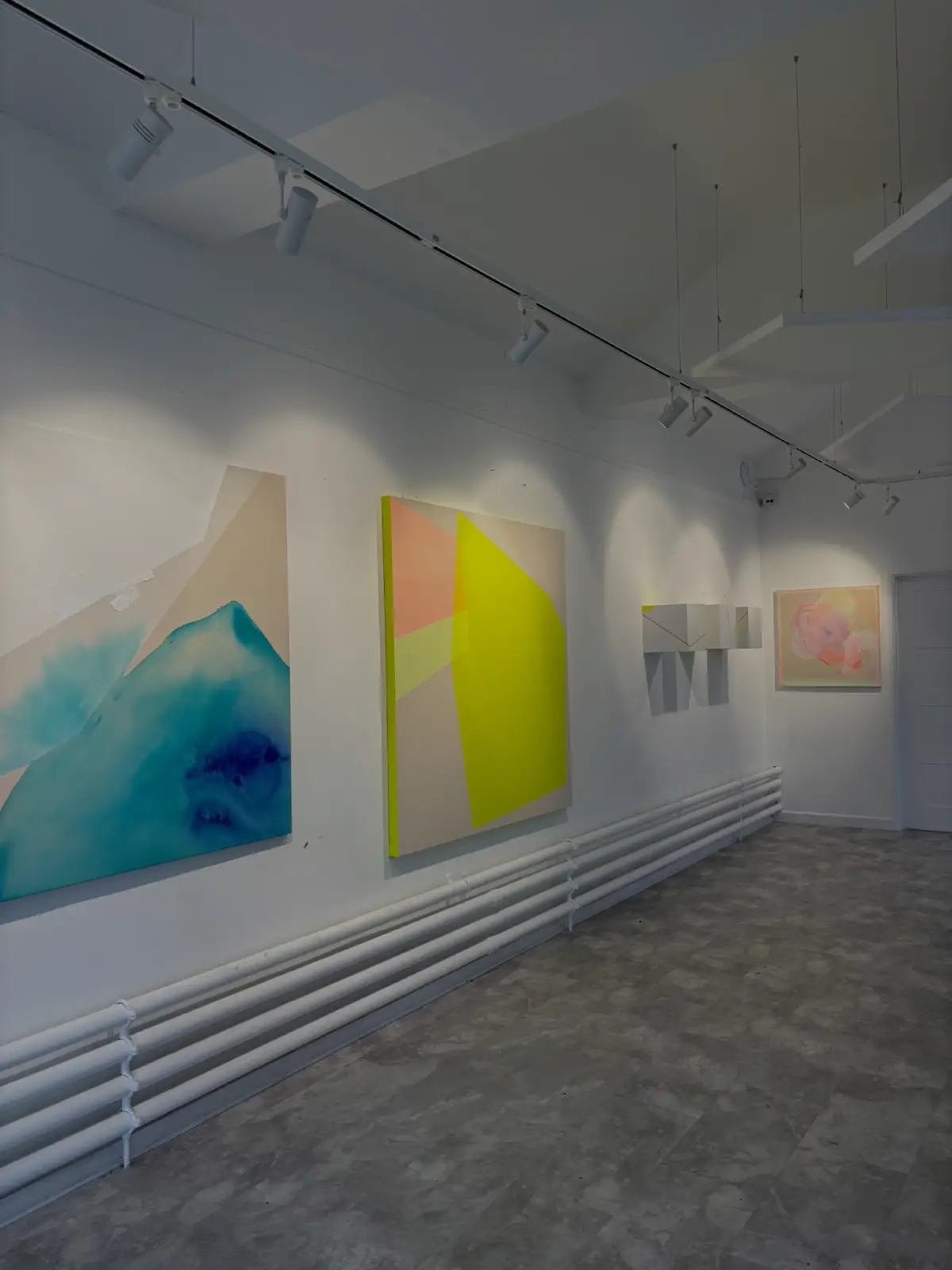
I took over a selection of recent works, pieces in 3D large scale works ad one or two older pieces to demonstrate how artwork practice can evolve and to show the different lines of enquiry that can emerge from an experimental approach to painting.
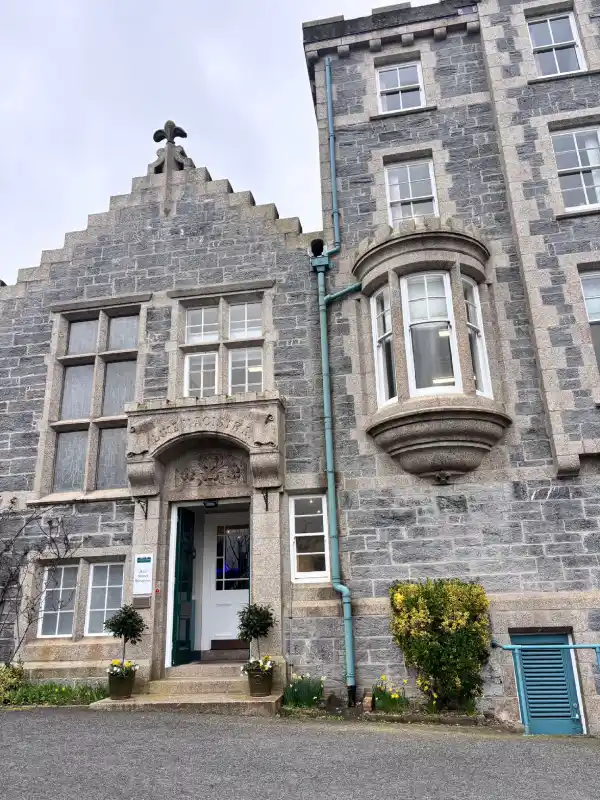
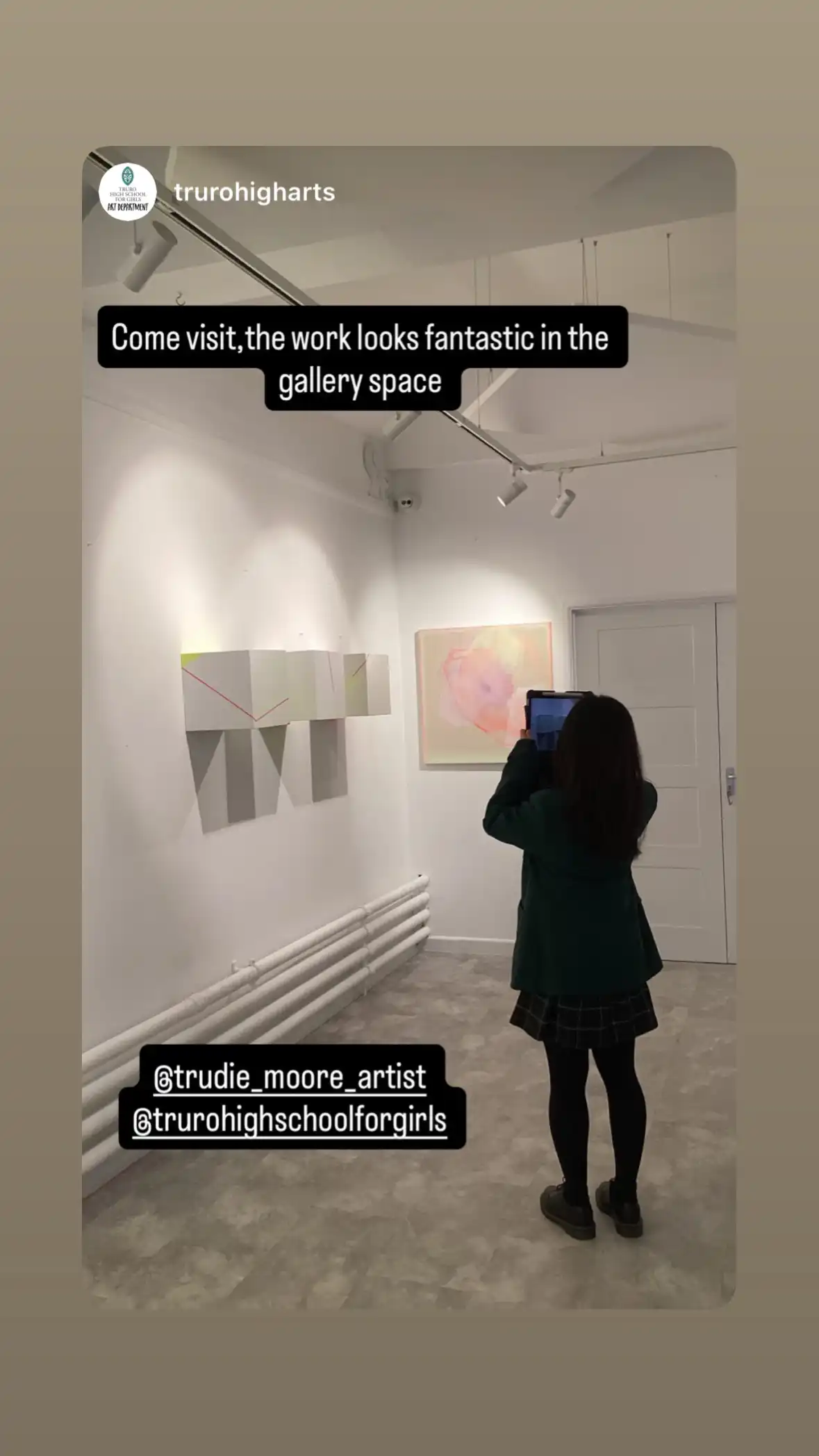
Truro High is really well equipped with a gallery to be able to run shows for the pupils and visiting artists and I had the freedom to start on new work whilst occupying the gallery which added depth and richness to the ways the pupils can see the work and understand the processes.
Different talking points around abstraction
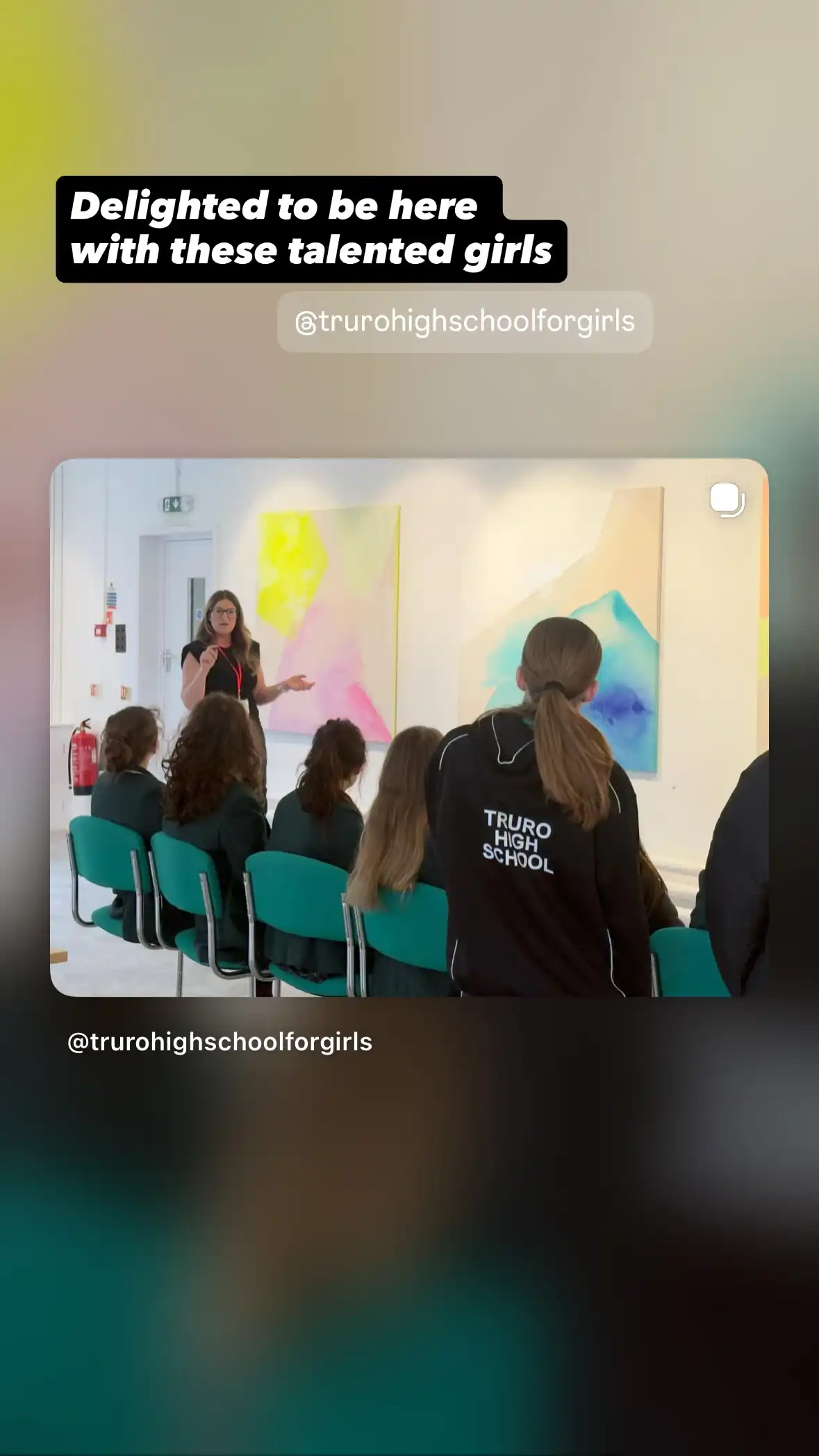
Together with year 9 we discussed a range of influences and concepts that go into my work and where those fit culturally. We explored ways in which other current artists use similar themes to mine ad how that sits within the context of modern art history.
I demonstrated how colour can reflect or create an emotion, and also how punk culture has used disruptive colour.
Also we had a look at balancing colour palettes with bold and energetic colour by adding softer tones, described the process painting techniques that painters such as Ian Davenport and Jackson Pollock utilised and how those have informed the materiality of my works. We covered how being precise about colour like Bridget Riley can be really important and about how slow processes lead to carefully decided actions, and how taking risks helps to find success.
Creating new pieces in week one
Week one of the residency gave me the opportunity to break away from thinking about existing works that have been lingering and to move on and cover some new ground. I don’t think I would have otherwise carved out the space so this has been a great nudge to make a start! Here’s what I did:
- Started smaller pieces on canvas and perspex
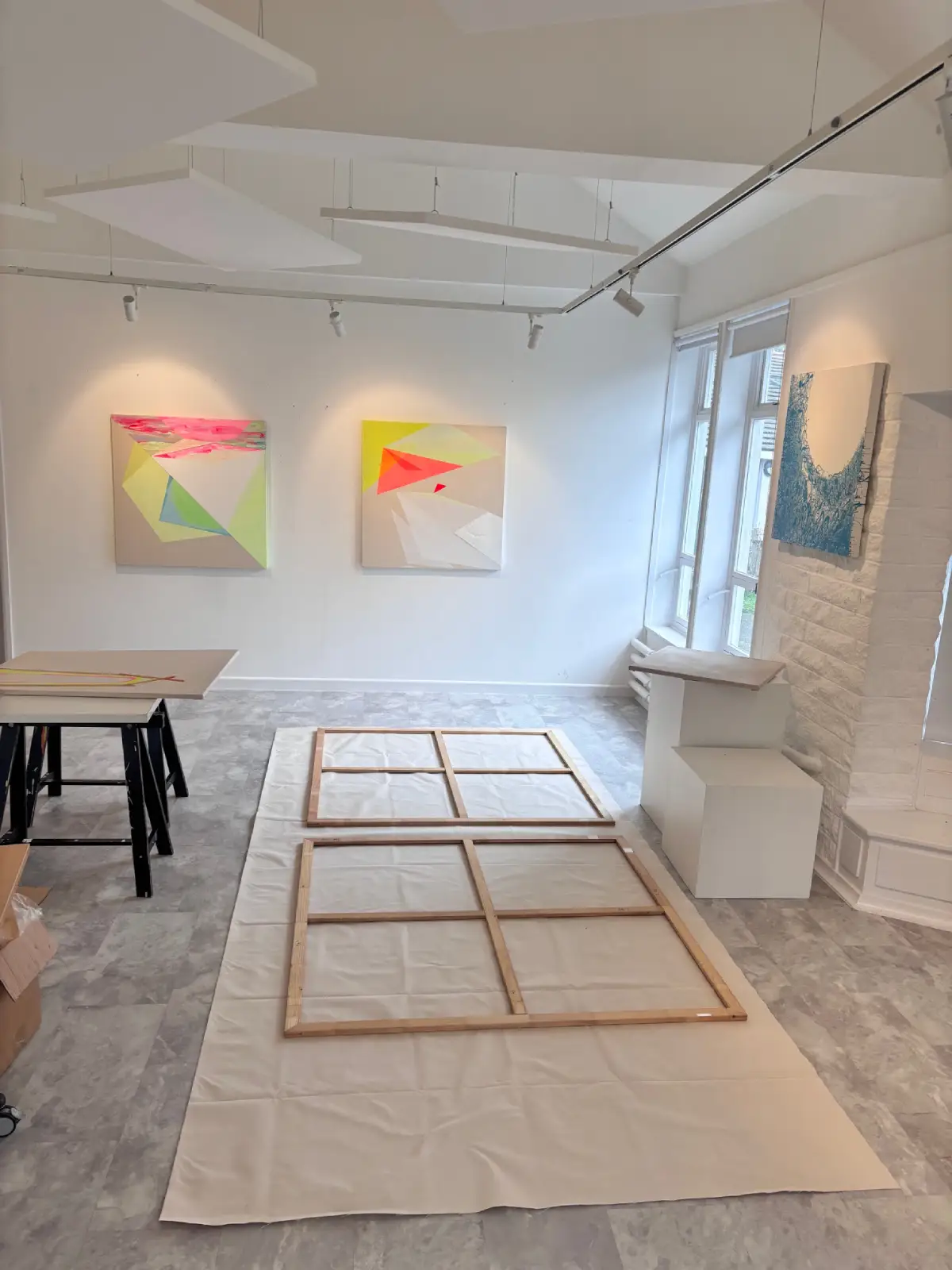
- Stretched some big canvases
- Paint fluid forms built in layers with more delicate colour palettes
- A couple of other completely different perspex experiments
- Some planning for a future project
- Coordinated some pieces on site that were chosen in advance for the properties that I wanted to talk to the pupils about
It was clear by the end of week one that the change of location and the feel of the place has put me into a different mindset and has stimulated some altered visual results both in terms of colour and form and relaxing the geometrics to create some fluidity.
I have taken away some of my own sets of rules around what the paintings need to be like and have delved into being a little freer. The perspex panels are a layered (front to back) painting and have been sat around in the studio for a long time with a lack of decision around starting them. Painting them now, in synchronicity with the smaller canvas has become a 3D layered triptych that partners the canvas so that when hung the two paintings can accompany one another in telling the story of the materiality.
I also did some work to one of the large canvases which started with a glimmer of a thought prior to beginning, but in the end I dived in and responded to the outcomes of the initial application as it started to form.
.
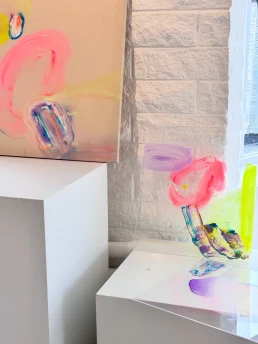
Talking about process, materials and switching the lights off!
With a smaller group of year 12 & 13 pupils we had a great time talking about the physical painting process, how a painting started, how I would make a start on the two large pieces I had just stretched and going from blank canvas to making the first ambitious and risky first move, but then moving past that to manipulating the materials and then allowing them to sit and find their place.
- We chatted about control of materials, and again, risking the painting while adding areas of colour and doing big pours and hoping for the best, but then appreciating the unplanned things that can happen and seeing where they take the painting. Then onto living with the artwork to see how it might develop and seeing how that can help with decision making as the piece progresses.
- We looked at the potential for different materials and different iterations of themes and how they would change a piece, such as canvas boxes being re-created in a transparent material and playing with the light to get the pieces to change and take on colour, shadow and then at how it adds dimensions that the viewer can see and feel.
- We demonstrated how multiple pieces can be considered as different strands of the same body of work, but seeing what different directions they go off in, and then viewing those variations that have happened over a period of time, whilst they look different, as being a cohesive collection (with a little side note on how this is very different in a fine art practice to being a commercial artist, where the same formula is repeated to create customer / viewer understanding and recognition). In this practice it’s about risk taking and developing ideas without rules in order to make discoveries that push the practice forwards.
When we looked at colour and the luminosity of the light on the paint we had a go at switching off the lights to see how the effect of changing the lighting might increase the charge of the colour in the dark ( as I was writing this and looking out of the window I spotted the sky switch to night mode, looked straight back at my phone and the notes app also did that!) also talking about the properties of phosphorescent paint and pigments and planning to create a ‘dark version’ of a piece that uses phosphorescent pigment to glow in low light and how using a range of the innovations in materials can help to change artwork.
We then moved on to finding out about their personal projects and seeing how this gives them an individual line of enquiry, and talking about how those themes fit into the diverse range of contemporary practice, artists and genres that could be used for helpful reference in developing those themes they are working with.
Finally, we also had a go at getting the girls to rate how they felt before and after the ‘colour bath’!! They returned back to the classroom and rated if they felt uplifted by the artworks.
Week 2 – progressing paintings and sparking an interest in abstraction
I was really chuffed to see lots of year 7 & 8 pupils in the gallery with watercolours doing studies on the artworks and finding parts of process, abstraction and composition that they found appealing that they could zone in on.
The works that I had started in week one progressed quite a long way with some huge bold moves on the two large canvases, one medium painting scrapped and some well considered progression on the perspex and smaller canvas. Sadly these had to be left to dry for some while as they are quite wet and so will take more attempts to complete in the studio, however I’ll photograph then and maybe will be able to bring them back to exhibit!
Thank you Truro High School for Girls for a truly memorable fortnight
It’s been a valuable time and if you have found this interesting and would like to come to a future exhibition please join my email list below or get in touch with me
Sign up to emails
If you would like to be invited to a private view, or receive notifications for exhibition, regular updates by email from the blog, then please sign up to my email list here
or follow on Instagram or my Facebook page

I once had a conversation about how I develop my paintings, do I plan them? The suggestion was that I could plot them up on on a computer before painting.
But despite the time to learn a way that suits me for this to work, I struggle with that as my brain works better by using the paint itself. And actually a lot of the time what I plan changes as I’m doing the painting.
I can lose the impact if I try to plan too much. Perhaps you could say it was a 2-way conversation with the painting where it starts to guide you. You could say this was an intuitive approach but I think it’s more of a collaborative process with each piece.
Or maybe I prefer to just enjoy the moment or the instant that something reveals itself to me. A bit like running. I hate to run out and back on the same path, the run back is too difficult or painful to endure, I like the constant change of the new all the time. To plan a painting and then paint it, I think kills the joy and the thrill/ tension in the moment of actually getting the idea direct to the painting.
But I do use a sketchbook so that I don’t lose ideas and thoughts when they hit me or when I want to work out how something is going to work.
And so with the development of paintings, I love nothing more than to work on several at once. If my mind goes off on a tangent with an idea I can do it on another painting instead of being solely tied into the one and then losing the idea by the time I’m done. And I can develop nuances I think of once I’ve started by running those thoughts and ideas across a group of paintings at once.
That’s what’s happening in this picture, several pieces in development at once feeding into one another, a neon hotbed of ideas!